

Seamanship and Small Arms Specialist
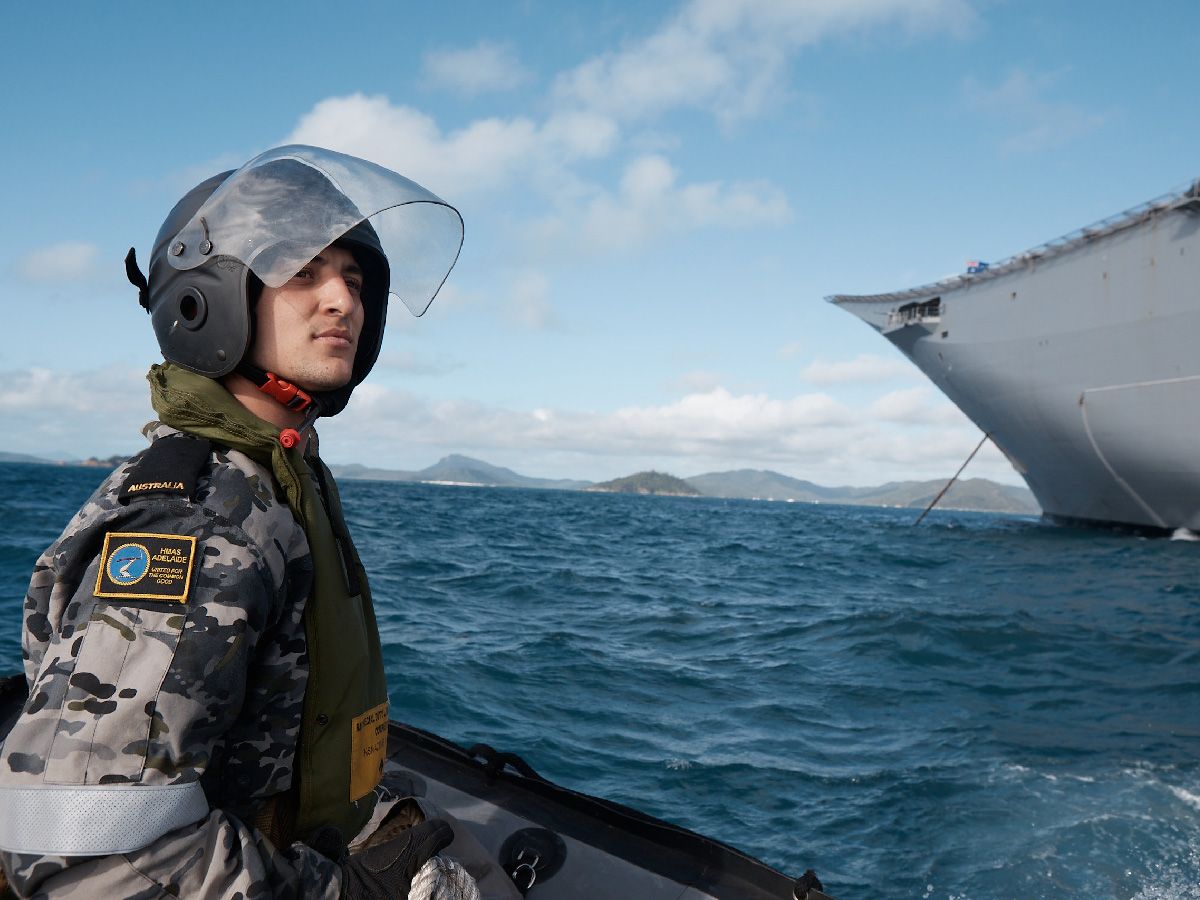
As a Seamanship and Small Arms Specialist, you'll specialise in small arms and close-range weapons, small boats and ships. You also look after the maintenance of the ship and ensure safety procedures are followed.
What you'll do
As an expert in operating and maintaining small arms and close-range weapons, you’ll be part of a hands-on team ensuring the everyday security, safety, maintenance and operations of the ship run smoothly.
You’ll work with a range of weapons that includes EF88 Austeyr rifle, F89 machine gun, 9mm pistol, 870P shotgun, batons, 12.7mm heavy machine guns and the Typhoon (an electro-optical remotely fired weapon system). With your skills and self-defence tactics training, you’ll be a core part of the ship’s defence and protection.
Your duties may include:
- operating and maintaining small arms and close-range weapons
- handling and driving small boats
- driving and steering the ship
- anchor work, berthing and towing
- replenishment (re-fuelling at sea)
- upkeep and maintenance of the ship
- maintaining rigging and associated equipment such as blocks, shackles and deck fittings
- boarding party
- force protection.
You'll also perform additional general duties that support the whole ship, including:
- ship security, firefighting and replenishment at sea
- boarding party, first aid, flood repair and flight deck
- assisting with medical, ammunitioning or ceremonial duties
- shift work, or on-call duties as required.
Opportunities for progression and upskilling continue throughout your career. As you progress, the Navy will provide you with development opportunities to assist you with your increasing leadership responsibility, as well as further education and specialised training within your chosen role. This will set you up to run a highly skilled team of sailors in a variety of tasks, both at sea and ashore.
After you’ve consolidated your training, you’ll have the opportunity to specialise as a navigator’s yeoman, shipborne lifesaving and survival equipment maintainer or an amphibious watercraft operator.
Following training, you could be based at one of the many Navy facilities located around the country. You’ll serve in fleet units and shore establishments on a rotational basis.
Discover where the Navy operates across Australia on our base locations map.

Requirements and training
You must be an Australian citizen to serve in the ADF. However, Australian permanent residents may be eligible. For more details, visit the "Citizenship" tab on the Eligibility Requirements page.
You can apply for a role in the ADF from 16.5 years of age and must be at least 17 to join. The maximum age to join is 58 years.
You don’t need a driver’s licence for this role but if you have one, it can’t be suspended or cancelled.
All ADF members require a security clearance. As an ADF member, you’ll need to obtain the appropriate level of security clearance for your role. You’ll need a collection of relevant information including background checks and/or interviews so the Australian Government Security Vetting Agency (AGSVA) can make an informed assessment to ensure the protection of Government resources and information. Your Careers Coach will explain what level of clearance is required for the career you are considering.
For more information or to learn about how security clearance will apply to you, view the eligibility requirements page.
Completion of Year 10 (or equivalent) education required with passes in English and Maths. If you haven't completed Year 10 but are interested in joining, the ADF may be able to support your application.
To join the Navy, it's important that you meet the necessary medical and physical requirements. Regular exercise prior to joining will set you up for success as it is an important part of training and service life.
Once you join, Navy will support your physical conditioning to ensure you're prepared to serve. You'll also have access to chef-made meals, gyms, sports and fitness sessions run by physical training instructors. Throughout your Navy career, you’ll be expected to conduct an annual fitness test which includes a plank as well as either a beep test or run/walk or swim.
During the application process you’ll be assessed through a questionnaire about your medical history and a physical examination.
The Navy swim test
During Navy Military Training, whether heading to the New Entry Sailor Course (Recruit School) or the New Entry Officer Course, you'll need to pass a swim test wearing your uniform to graduate. This includes:
- safety jump off a 3m tower
- 10m underwater swim
- 50m swim using survival strokes
- treading water or floating for 15 minutes.
For further details on medical and physical fitness standards, refer to physical fitness standards for entry into the ADF and medical process for entry into the ADF.
You’ll be enlisted for an Initial Minimum Period of Service (IMPS) of 2 years. Subsequent periods of service may be offered subject to the requirements of the ADF and your suitability for further service. You’ll have a Careers Coach who can advise on how IMPS will relate to your chosen occupation and personal situation.
You may request discharge at any time provided you do not have an outstanding IMPS obligation.
Course: New Entry Sailor Course (NESC)
Duration: 10 weeks
Location: Recruit School at HMAS Cerberus, Vic
You’ll conduct your initial sailor training at the Royal Australian Navy (RAN) Recruit School prior to commencing specific category training. The NESC course is designed to prepare you to conduct basic duties as a sailor.
NESC Course
- Physical fitness: General fitness and the Navy swim test.
- Military life: General service knowledge including drill and ceremonial procedures.
- Specialty skills: Weapons training, workplace safety, first aid and sailing.
- Navy skills: Seamanship, corrosion control, survival at sea and fire and flood control.
After successfully completing all components of the course, you’ll participate in a Graduation Parade to mark the occasion. You’ll have the opportunity to invite family and friends to view the parade.
On completion of your NESC course, you’ll proceed to your respective employment training.
Course: Boatswain's Mate Initial Employment Training Course
Duration: 23 weeks
Location: Maritime Skills Training Centre, HMAS Cerberus, Vic
This course is broken down into two phases.
Maritime Combat and Security
- mastery of defence service weapons including the EF88 AUSTEYR, F89 Minimi, 870p Shotgun, MAG 58 and 9mm Pistol
- use of less-than-lethal weapons and tactics, such as batons, and personal defensive techniques
- training to diffuse situations and how to apply the appropriate level of reasonable and necessary force to control a situation
- operation of a ship's close-range weapons system including 12.7mm machine gun and Typhoon weapon mounts
- providing visual direction of medium range gunnery systems
- training in domestic boarding party duties for fisheries and other enforcement operations.
Initial Seamanship training
- launch and recovery of sea boats
- training as a Rigid Hull Inflatable Boat (RHIB) Coxswain and Bowman
- working with all types of cordage and understanding the characteristics and splicing techniques of these materials
- use and maintenance of rigging, blocks, slips and shackles
- maintenance of ships and boats anchors and cables and acting as a member of a ship's cable party
- heavy seamanship tasks including replenishment at sea (refuelling, ammunitioning and essential stores)
- a working knowledge of a ship’s organisational routines
- docking, berthing and unberthing of ships, incorporating line handling for evolutions and erecting awnings
- Watch on Deck (WOD) duties, including lookouts, Quarter Master Assistant (QMA), and helmsmanship (steering the warship)
- man overboard recovery methods by sea boat and swimmer
- working at heights.
After you have consolidated your initial training at sea for at least 12 months, you can choose to specialise in one of the following areas:
- navigator's yeoman
- shipborne lifesaving and survival equipment maintainer
- amphibious watercraft operator.